
 Svenska
  Español
  Nederlands
  Deutsch
  België
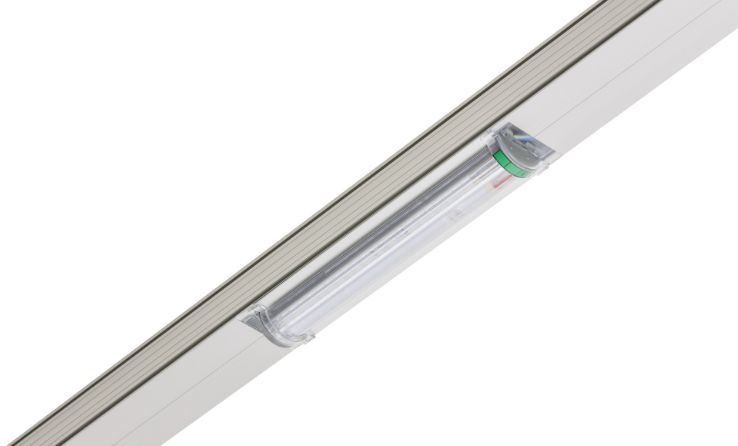
Central Emergency Lighting
Description
Recurring maintenance constitutes the greatest cost related to emergency lighting, as the batteries must be replaced every four years. If the batteries are located in the light line just below the roof, replacing them is labour-intensive. In addition, the life of the batteries is shortened by temperature fluctuations under the roof. With a central battery station, the battery is located on the ground floor, easily accessible and in a controlled environment. This increases the average lifespan of a battery to nine years. The emergency luminaires are tested automatically. The online system further allows malfunctions to be reported automatically. Maintenance is performed only when necessary, as facility managers receive an email stating the exact location of any faulty safety fixture. Just imagine how much money, time and effort this could save.
Specifications
| IP code | IP40 - IP65 |
|
Length |
300 mm |
|
Application |
Industrial areas, sports venues, swimming pools, retail, parking garages and cold stores |
|
Installation height |
2 - 20 m |
|
Colour temperature |
4000 K |
|
Lens options |
Narrow, Semi Wide, Wide, X-Wide, Diffuse and Circular |
|
Impact resistance |
IK10 |
|
Options |
DALI, Eaton or fixed driver |
|
BREEAM |
Yes |

FAQ
Is it possible to incorporate emergency lighting in a linear lighting system?
Yes, both central and decentralised emergency lighting are possible.
What are Veko's warranty conditions?
By default, Veko supplies all LED luminaires with a unique replacement warranty of 5 years or 25,000 operational hours. Furthermore, Veko applies a 3-year warranty for batteries and emergency modules for the purpose of emergency fixtures, and a 5-year warranty to all other products.
In case Veko has installed the lighting, we will check it between 200 operational hours and 1 year after delivery once and repair any defects. A detailed description of the warranty terms of Veko Lightsystems International can be found in article 17 of our general terms and conditions. For local sales within the UK, article 15 of the general terms and conditions of Veko Lightsystems Ltd is applicable.
In some cases, we can even provide 10 years warranty on LED fixtures. More information about this can be provided upon request. The full guarantee plan can be obtained from Veko.
How can I get advice on my lighting system?
Our account managers are happy to visit you for a consultation. Please contact us for an appointment.